

1968 was turbulent all around the world. For France, it was no different. The conservative president Charles de Gaulle was still in power. The controversial Algerian War had unsettled the populace. France was abandoning its position as colonialist overload of Vietnam as America escalated its own war against communism in that nation. The police had been militarized in anticipation of social upheavals. The young generation of postwar students were getting anxious and the labor unions were looking for new reasons to agitate the national workforce. The fires of political protest were sweeping throughout America, England, Germany, Czechoslovakia, and Japan and it was time for France to get caught up in all of that too.
It all started small. A group of students at the Paris University of Nanterre wanted to spend more time with their girlfriends. The female dorms had strict time limitations and curfews for male visitors. The Sexual Revolution was building momentum and there were a lot of boy and girl students who wanted greater access to each other. They held a couple small demonstrations in the Spring of 1968 and, unpredictably, they began to attract a larger and larger number of students.
Earlier that year, France’s Communist and Socialist Parties had agreed to form a coalition to replace Charles de Gaulle as prime minister of France. Activists at Nanterre saw the small demonstrations as a potential flashpoint to start an uprising and began getting more and more disgruntled students involved. So on March 22, 150 student agitators occupied a university administration building and drew up a list of demands. The police surrounded Nanterre and allowed the occupiers to publicly state their grievances. Then they were allowed to leave without being attacked, although the ring leaders were later brought in for disciplinary actions. They were later celebrated as heroes and that day was commemorated by christening it the Movement of 22 March.
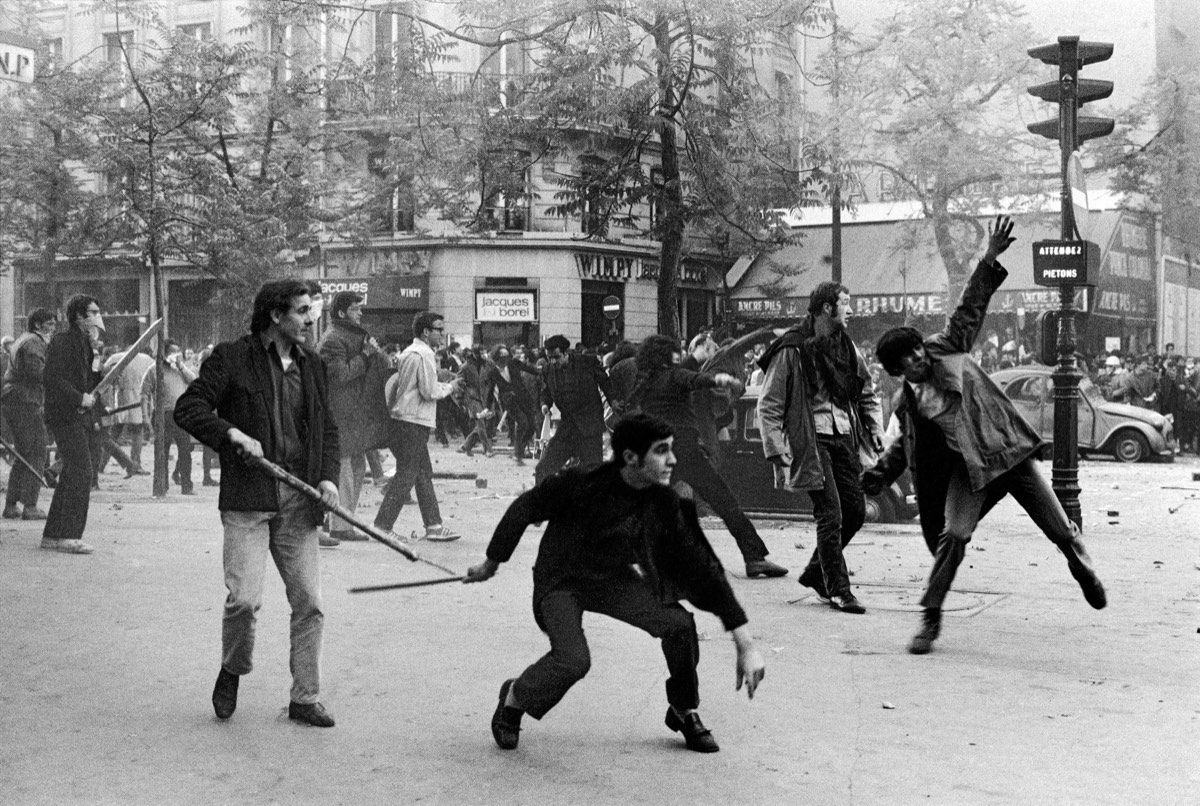
Demonstrations at Nanterre continued throughout April, disrupting ordinary affairs until May 2 when the university officials closed the university and threatened to expel the students who were responsible. Across town, at the Sorbonne campus of the University of Paris, students went on strike to protest the closure of Naterre. The police were called in to maintain order; they surrounded the Sorbonne campus and sealed it off to prevent anyone from coming or going. On May 3, students from Nanterre and other universities in Paris marched on the Sorbonne. They were joined by high school students and educators who were organized by the teacher’s union. 20,000 people arrived and began to attack the police. Barriers were built with any materials or debris they could find in the immediate area and the mob began throwing rocks and bricks. The police decided to retreat but soon returned wearing riot gear. The crowds were blasted with tear gas, being trampled and beaten with batons as the cops chased them away.
Later in the week, students began returning to their campuses but when they arrived they found a police occupation. On Friday May 10, crowds began to gather at the Rive Gauche. The police attacked them so they set up barricades and the riots started again. Cars were burned and molotov cocktails were thrown. The disturbances lasted through the night and ended at dawn. The next day, images of the fighting were broadcast on television and the general public were horrified by the police brutality.
The next day, over a million protesters marched through Paris. The Prime Minister Georges Pompidou went into hiding and called for the police to leave Sorbonne and released all the rioters who had been arrested. The students returned to the university but they became more violent, throwing rocks and bricks at the authorities. More barricades were set up and students occupied the campus, declaring it to be an autonomous people’s zone.
All throughout the city, graffiti was written by anonymous protesters. Slogans like “It is forbidden to forbid” and “Be realistic, demand the impossible” could be read on walls and sidewalks. Some of these ideas became conventional wisdom for the upcoming generation of new radicals. Pamphlets, booklets, and chapbooks were also circulated, free of charge, throughout the crowds. They outlined revolutionary schemes and ideologies written by communists, socialists, anarchists, and artists. One pamphlet going around was published without copyright by the Situationist International, an offspring of the Surrealist art movement that morphed into an anarchist urban guerilla outfit. The manifesto, written by a young filmmaker named Guy Debord, was titled Society Of the Spectacle. It would go on to obtain cult status in postmodernist and activists intellectual circles.
Meanwhile, throughout all the neighborhoods of Paris, people began organizing popular action committees. They held meetings to discuss their grievances against the government and laid out plans to petition for change. Over 400 committees were formed. The mainstream of society had joined in with the revolt.
The tides began to turn on Saturday night when the leaders of the student demonstrations were interviewed on television. People watching at home were disappointed by their lack of direction, destructive ambitions, and utopian ideologies. The student leaders wanted to tear down the capitalist system and end the consumerist society but they had no real plans for what to do after that happened. Popular support for the movement began to gradually wane. But the protest movement was far from over.
Not only young people in other parts of France begin to protest; blue collar workers all over the country, but mostly in Paris, declared a general strike. Influenced by student Communist Party activists, the Proletariat laborers, most especially the factory and farm workers, demanded ownership of their workplaces and the resignation of President de Gaulle. To calm the tensions, the labor unions made a deal with the business owners to increase wages by a heft 35%, shorten working hours, and provide more vacation time. The striking workers refused to accept this bargain. Their demands were more radical and more political. Some student demonstrators took note of the general strike and began showing up at the factories to sit with the idle laborers and support their picket lines. Some activists entered the factories and spent time talking to the workers, getting to know them and forming alliances.
Towards the end of the month, while still on strike, the working classes, students, and Communist Party officials held a rally in a football stadium. As the day wore on, speaker after speaker came to the microphone and made speeches about overthrowing the government and radically altering the foundations of French society. But the proletariat and the student would-be revolutionaries had different agendas and by the end of the rally it was obvious they could lend each other little more than verbal support.
On May 24 and 26, the only two deaths of May ‘68 were reported. In Lyon, rioters set a driverless truck into motion. It crashed into a line of police and killed one of them. Two days later in Paris, a 26 year old activist got into a fight with another demonstrator who stabbed him to death. In later years when police were confronted with their brutal and militaristic tactics of crowd control during those times, they responded by saying that they were proud of their actions because they themselves never killed anyone.
While the rally was happening, the Socialist Party’s leader, Francois Mitterand, held meetings with government officials to discuss forming a new government. Surprisingly, the politicians wanted to include the Communist Party in their committees. The demonstrators were largely supporters of communist ideology and their numbers were large enough that it was thought they should be allowed to discuss their demands. The Socialist Party had more support from the general populace but they agreed to allow the Communists to attend planning sessions.
The conferences were scheduled for May 29 but got canceled because on the morning of that same day, Charles de Gaulle, fearing the start of a revolution, fled the country. He handed power over to Prime Minster Georges Pompidou who, for a short time, ran the government by himself. The government collapsed when members of the National Assembly began to flee. Documents were destroyed, money was stolen, and a lot of politicians tried to cross the borders to escape to other countries. Somebody gave Georges Pompidou a gun and told him to keep it close in case he needed it. No one knew where de Gaulle had gone.
Later that night, Pompidou learned that de Gaulle was over the border in Germany, plotting his return with a member of the military, General Jacques Massu. At that point, de Gaulle had grave doubts about his ability to continue leading France. He felt that he had lost the support of his people. Part of their plot for his return included plans for getting his family out of France if he were assassinated or unable to restore order in his country.
On May 30, the Communist Party called for a march. A crowd of 500,000 gathered at the President’s palace on Champs Elysee. Pompidou was expecting a violent revolution to begin so he called out the riot squads and snipers, ordering them to shoot to kill if anything got out of hand. He also ordered tanks onto the streets of the countryside, surrounding Paris in case the demonstrators tried to escape. He mistakenly believed the they would start fighting then leave the city, regroup on the outskirts, and return to make tactical strikes using guerilla warfare techniques. But the Communists were not into violence. Their objective was to call for conferences and negotiations. They wanted their entry into politics to be done legally and peacefully. Some scholars have argued that if the military and police had clamped down with violence, then public opinion would have turned to greater support for the revolutionaries. All sides played their hands wisely that day.
On May 30, Charles de Gaulle, back in France, appeared on television and announced that he would not resign. He also explained that the military had surrounded Paris in case a revolution began. But on the brighter side, he called for elections to be held at the end of June and Communist Party members would be on the ballot. After the broadcast, one million supporters of the government marched on the Champs Elysees, waving French flags. The call for revolution was over. The workers returned to work. The college year ended and the students returned home for the summer.
The election in June resulted in a loss for Charles de Gaulle. The Communist Party gained a small number of seats in the National Assembly and the Socialist Party lost most of theirs. Some small, spontaneous demonstrations happened after that but the uprising of May was over.
Blue collar workers and left wing activists were unable to hold their fragile alliance together and went their separate ways. An experimental commune was set up outside Paris, though. A handful of anarchist squatters, leftist journalists from a newspaper published by Jean-Paul Sartre, and farmers with radical views attempted to form a co-op but the project lasted a very short time. The more educated activists looked on in dismay as the farmers took to fighting and bickering with each other; in the end, they refused to cooperate and the commune dissolved.
In the long run, May ‘68 was increasingly seen as a turning point for the French left wing. It inaugurated the New Left movement in France. But this movement was less involved in demonstrations, strikes, and riots. Instead, a class of French intelligentsia formed and turned to philosophy and intellectualism instead. For better or worse, the arcane, and often confusing, disciplines of postmodernism, poststructuralism, deconstruction, and critical theory became a mainstay in Western university humanities departments. Many believe these theoretical styles have done more harm than good when furthering the cause of left wing politics.
So what was May ‘68 really all about? There is no general consens. Both left wing and right wing public intellectuals have tried to dominate this narrative to support their own agendas. Many people supported the uprising for many different reasons, bringing their own complaints and ideas into the mix. It came and went like a spontaneous explosion of existential frustrations. In the end, there were no effective leaders with clearly stated goals to seize power and direct the demonstrations towards a higher cause. It all fizzled out quickly, leaving not much but an election and a lot of nostalgia. Strikes and demonstrations are now common in France and the capitalist establishment continues on with relative stability, able to withstand the shocks and upheavals that arise every so often.
Judt, Tony. Postwar: A History of Europe Since 1945. Penguin Books, New York: 2006.
Ross, Kristin. May ‘68 and Its Afterlives. The University of Chicago Press, Chicago and London: 2008.
photo credits:


